Thursday, 3 October 2013

Walking

As part of our private study activities we have had to research three artists who use walking as part of their creative process.

After researching Sophie Calle the other day I remembered one of her projects 'The Shadow' involved walking. In The Shadow, Calle was followed for a day by a private detective she had got her mother to hire for her and led him around the parts of Paris that were important to her. She recorded her experience through photography and writing whilst the detective also photographed her, not knowing that she was aware of being followed. This gave a different perspective on the different routes and movements from the two different people, showing that an experience of the same walk or day is subjective to every person. I think this piece of work is interesting because it subverts the traditional idea of a photographer simply taking photos of a subject.

From The Shadow


Francis Alys is another artist who uses walking. In The Collector in collaboration with Felipe Sanabria, a magnetised dog cart is walked through Mexico City and picks up objects on the way. I think this is an interesting concept because it adds an element of randomness to what is encountered and collected on the walk.
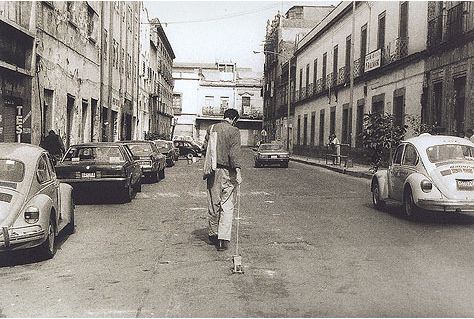
 From The Collector


The Walking Man Diary by Ian Breakwell is another example. One day the artist started cataloguing the appearance of a man who would regularly walk round the Smithfield area of London not doing anything in particular. I find this interesting because it gives an idea of how our lives can be interlinked with others and yet we know very little about that other person - their motives for walking where they do are unknown to us.

The Walking Man Diary

Wednesday, 2 October 2013

Out-takes/not following brief

So for the actual homework we were only meant to use our two pound shop things but I did some extras with different objects so here they are


 This one is blurry eww but I like the composition. ^^


Pound Shop Project

For one of our independent study projects we had to go to a pound shop and buy two things and explore different ways of joining them together. I bought a pirate skull mask and sword set, and a purple 'wig'.


I decided to use photography to do the brief because I felt that it would suit my objects well.


Monday, 30 September 2013

Drawing with different methods

Today we were looking at using experimental drawing techniques. For example, drawing with boot polish, thread, masking tape and paper etc. I'll probably put some pictures of what I did up soon.

One artist who uses experimental media to draw with is Gavin Turk. Here he has used overlapping tea stains to create cylindrical looking forms. I think that this works well as it is reminiscent of woodcut or potato printing and yet it is subverting the genre of what constitutes art. I also like the varying tones of the tea stains as this gives an interesting effect.

Sophie Calle, The Hotel, Room 29


This series intrigues me because it is artwork created by such an unusual process. When people think of art or photography they are unlikely to think of a person elaborately pretending to be something that they are not to gain access to information about people they don't know. In this way creating this series Sophie Calle seems more like a spy or detective than an artist. Also the fact that she was working as a cleaner in order to build up this series and had a role to perform adds an element of performance art.

All of Calle's work that I have seen I find very interesting and original. This may be partly down to the fact that after leaving school she travelled for seven years which may have given her a unique perspective on the world.

I feel like it would be interesting to have a film of her life.

Damien Hirst, This Little Piggy Went to Market, This Little Piggy Stayed at Home

We've moved on to exploring Fine Art now so today we have been looking at some Fine Artists. We've already established that Fine Art can basically be anything as long as there is a concept behind it.

One of the artists we looked at was Damien Hirst. I've never quite been able to understand his 'Natural History' series with the animal suspended in formaldehyde but I think it's clicked more for me today. I realised that it is basically a natural extension of anatomical drawing and could have its links to this. In this way it could be seen to be making a connection between past methods of art and modern ones. People are often shocked by the use of animals in Damien Hirst's work but if you think about it all the great animal painters of the past were experienced in anatomy which involved dissections and such like. For example George Stubbs dissected a lot of horses to be able to do the paintings he did but because the direct result of his work is merely a painting of a live horse and not a real dead animal, people would tend not to think of the fact that animals have died to create that work too.
I don't know if that paragraph makes any sense.


But anyway the concept behind this piece is being in two minds about something. The two cases slide backwards and forwards from each other so sometimes the pig will look whole but at other times in two halves. This definitely builds up an idea of the pull between two different ideas or plans when you can't decide something. However did this concept really require a pig in formaldehyde? I would argue, probably not.

Friday, 20 September 2013

Dawn Dupree

Another artist whose use of colour is important in their work is Dawn Dupree, a textile designer. I like the choice of subdued, muted tones in this piece because it gives a quiet, reflective and quite nostalgic atmosphere. But again there are some spots of warm colour to help balance and lift it. I think this shows that it is important to include both warm and cool colours in a colour palette. I also like this choice of colours because it reminds me of traditional Chinese painting, as well as the prominence of the red sun.